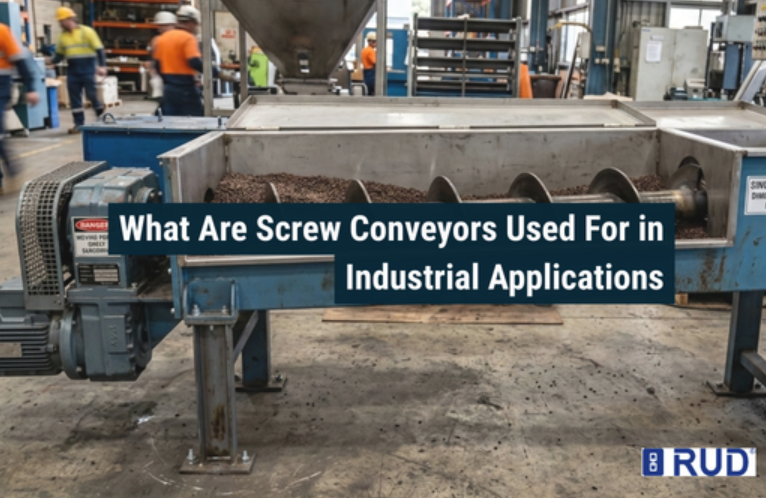
Screw conveyors are used in industrial applications to move bulk materials, including grain, cement, sludge, and sand, from one point to another with minimal manual handling. But most operations get stuck trying to figure out which system suits their site. And we really get why.
The range of conveyor systems out there is wide, the terminology can be confusing, and the wrong choice leads to blockages, downtime, and wasted money. At RUD Australia, we’ve helped industries across Australia sort through this.
In this article, we’ll cover how screw conveyors work, what materials they handle, and how to find the right fit for your operation. By the end, you’ll have a clear picture of what works and why.
What Is a Screw Conveyor?
A screw conveyor is a mechanical device that moves materials through a rotating helical blade, also called a flight, fixed inside a tube or open trough.
The concept is simple. As the blade spins, it pushes material forward along the conveyor until it reaches its intended point. While it’s one of the oldest forms of material conveying in engineering, it still holds up remarkably well in modern operations.
Put simply, the design works because it’s reliable. These conveyors handle moving materials across some of Australia’s most demanding industrial sites.
The Core Job: Moving Materials From A to B
Screw conveyors do one job, and they do it well. They move materials from point A to point B consistently and with minimal effort. But the way they manage that job depends heavily on what you’re moving and how your site is set up.
Take a closer look at how that works in practice:
How Bulk Materials Handling Actually Works
Bulk materials handling is the process of moving, storing, and controlling loose materials in large quantities across a facility. With screw conveyors, the rotating blade does most of the work and pushes material steadily along the system until it reaches its final destination.
Speed and angle also play a role here. A steeper incline slows throughput, while a faster rotation can cause material to scatter rather than flow cleanly through the conveying system.
What Kinds of Materials Can They Move?
Raw materials like grain, sand, and coal move through these systems easily, and so do processed materials like flour, cement powder, and chemical compounds.
However, material density and moisture content both affect how well a screw conveyor moves the load. Wet or sticky materials need a different design approach compared to dry, free-flowing bulk materials handling applications.
Where Screw Conveyors Show Up on the Job
Screw conveyors are used across mining, food and beverage, water treatment plants, and other industrial sectors where moving bulk materials quickly and reliably is part of the daily operation.
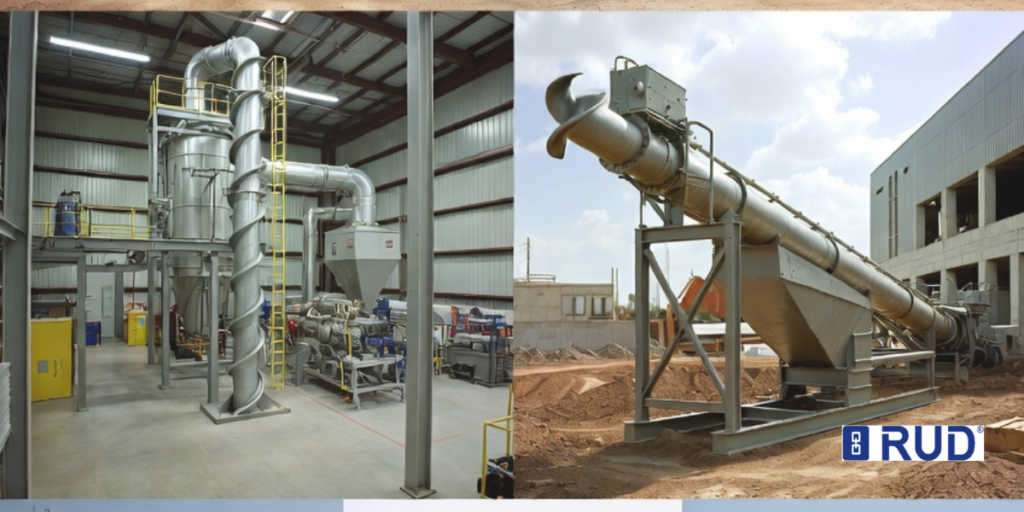
If a facility needs to move loose or bulk materials without manual handling, there’s a good chance a screw conveyor is already doing that job somewhere on site. Some of the most common places you’ll find them at work:
- Food and Beverage Processing Facilities: Moving ingredients like flour, sugar, and grain along the production line.
- Water Treatment Plants: The enclosed conveying systems here handle sludge and waste materials with minimal spillage.
- Mining and Construction Sites: Transporting raw materials like sand, gravel, and coal between processing points.
- Automotive and Rubber Manufacturing: These industries move bulk material components between workstations and factory floors quickly and easily.
- Warehousing and Transport Operations: After production wraps up, screw conveyors keep moving finished goods and boxes through to their final handling stage.
So now that you know where screw conveyors are used, the next question worth asking is whether a standalone unit is enough for your operation, or whether you need something more substantial.
Conveyor Systems: Standalone or Part of a Bigger Setup?
A single screw conveyor can handle a straightforward transfer job on its own. But in most industrial operations, it’s rarely working alone. Most conveyor systems bring multiple components together, including:
Think about it this way. A grain processing facility in Brisbane might use a screw conveyor to feed material into a hopper, which then connects to a belt system that carries it across the warehousing area and into the next production stage. That’s logistics, automation, and material handling all working as one system.
And that’s exactly why getting the design right from the start is essential. A poorly planned layout creates bottlenecks that slow down the entire production line over time.
See also: Techsslaash Com: Exploring the Latest Trends in Technology
Screw Conveyor Types at a Glance
Picking the wrong screw conveyor for your material or site conditions is one of the most common, costly oversights in conveyor system design. Here’s a quick breakdown to help you avoid that:
| Type | Best For | Key Feature |
| Standard Screw | Dry, free-flowing materials | Simple mechanical design, easy maintenance |
| Shaftless Screw | Sticky, fibrous, or wet materials | No central shaft, reduces blockages |
| Inclined Screw | Elevated conveying between levels | Angle-adjusted for controlled material flow |
| Pneumatic | Fine or powdered materials | Uses air pressure instead of mechanical parts |
| Belt Conveyors | Heavy or abrasive bulk materials | Rubber belt suits high-capacity, long-distance runs |
Each type has a minimum capacity threshold and a ceiling, so testing your material type against these options early saves a lot of grief down the track.
A shaftless design, for example, handles wet sludge far better than a standard unit ever could. So if you have sticky, fibrous, or high-moisture materials on site, that’s the one to choose, or else you may end up paying for a specialised design you can’t even use.
At the end of the day, the right conveyor suits your materials, your site layout, and your production goals.
Customised Solutions for Unusual Jobs
Off-the-shelf conveyor systems rarely account for the quirks of a real job site. You might be thinking that a standard unit will do the job, but the capabilities of a customised screw conveyor go well beyond what most people expect.
Situations like this show why customised design counts:
Micro Projects and Tight Spaces
Drawing from our experience, compact screw conveyors built for smaller installations are among the most requested customised solutions we handle. Not every facility has a wide open floor, which is exactly why a custom-built unit is often the only practical way forward.
Multi-Site Global Installations
Multi-site global installations require screw conveyor systems that perform consistently across different locations, climates, and regulatory environments. That means every conveyor, every component, and every commissioning process needs to meet the same standard. And that’s not something you can achieve with a one-size-fits-all approach.
The Handling Equipment Behind Major Australian Companies
From what we’ve seen across projects with major Australian companies, one thing is clear. The businesses that run the smoothest operations don’t just buy any conveyor system. Rather, they invest in handling equipment that’s built to last, supported by a team that understands local conditions, regulations, and the real cost of downtime.
And the numbers don’t lie on this one. Downtime in bulk material handling costs far more than the equipment itself. For instance, a single unplanned stoppage on a high-volume production line can set a business back tens of thousands of dollars in lost output and supply chain delays.
That’s why suppliers like RUD Australia tend to cut through the noise here. We’re present on the ground, and we understand industry demands across Australia.
Bottom Line: A good supplier manages the full project from concept through to commissioning. That means fewer delays, cleaner installation, and a system that’s actually built for your site from day one.
FAQs About Screw Conveyors
The best way to know if a screw conveyor suits your operation is to ask the important questions first. Here are the ones we hear most often:
Q: How often do screw conveyors need servicing, and what does upkeep involve?
Most screw conveyors need routine maintenance every 3 to 6 months, depending on the material they manage and how often they run. That typically covers bearing checks, blade wear inspections, and lubrication of mechanical components.
Q: Can screw conveyors handle wet or sticky materials without blocking up?
Yes, but not every type can. Manufacturers build shaftless screw conveyors specifically for wet, sticky, or fibrous materials. A standard unit will block up fast under those conditions, so bulk type drives the decision here.
Q: How do I know which screw conveyor is right for my site?
Start with your material type, site layout, and required handling capacity. From there, an experienced engineering team can match the exact system to your needs and flag any safety or compliance requirements early in the process.
Ready to Move More, Stress Less?
Screw conveyors are one of the most dependable material handling solutions in industrial operations, and now you’ve got a solid grip on why.
RUD Australia delivers customised solutions across micro projects and large-scale industrial installations alike. Our team handles everything, including initial design, training, and ongoing support. That way, you can achieve reliable, efficient conveying operations with minimum hassle.